Monday, August 1, 2011

Toyota Kijang

The Kijang is a pick-up or minibus sold in Indonesia and Brunei, made by Toyota. "Kijang", meaning deer/muntjac in Indonesian, was first introduced in Indonesia in 1977 and it has become the most popular car in the country ever since[citation needed]. This car is also sold in other countries, and is known as the Unser in Malaysia (Innova for the fourth generation), Zace in Taiwan, Qualis and Innova in India, Nepal, and the Philippines, and Stallion and Condor in South Africa. The original Kijang is known as the Revo in the Philippines (see the Revo for the history of the Tamaraw and Tamaraw FX).
It is relatively affordable in the markets where sold when compared to four-wheel drive vehicles (the Kijang is a two-wheel drive) and features high seating capacity, large ground clearance and rugged suspension, popular features in an area with generally poor road quality and large extended families.
In Indonesia, typically the whole extended family climbs in before even short trips, just for the adventure, as opposed to true car-pooling. The family Kijang is treated with love and many get professionally detailed every month[citation needed]. Depending on a person's size, the vehicle can carry as many as 9-15 passengers[citation needed], since many of the countries the Kijang is sold in do not require safety belt usage at that time[citation needed].


Engine Interior Toyota Kijang


Green Toyota Kijang Hatchback


Blue Toyota Kijang Concpet


Driving Interior Toyota Kijang 


Toyota Kijang On Parking Area


Toyota Innova 2011

The Toyota Innova is a Toyota-designed MPV i.e. being less than 4,600 mm (181.1 in) in length as per the European system of size classification, produced in Indonesia under supervision by Toyota Astra Motor since 2003. As with Toyota Kijang, which it replaced, the Toyota Innova is produced and first marketed in 2004 in Indonesia. Toyota Innova is part of Toyota's IMV program together with the Hilux Vigo pickup truck and the Fortuner SUV. Its official name in Indonesia is Toyota Kijang Innova, while for other countries it is simply Innova.

Powering the Innova is either a gasoline 2.0 liter 136 PS (100 kW) 1TR-FE VVT-i, a 2.7 liter (2TR-FE) version of the same, or a 2.5 liter 102 PS (75 kW) 2KD-FTV D4-D common rail variable geometry turbocharger diesel engine. Trim levels are J, E, G, and V. The 2.7 liter is only for the V, with automatic transmission. The Innova features a live rear axle and it is of front engined, rear wheel drive configuration. The newly added V variant adds ABS, leather seats and captain chairs.


Silver Toyota Innova Look so Elegant

Toyota Innova with a facelift

It has a new engine, different from the older Kijang gasoline engine. Unfortunately, while the new engine produces more power (2,000 cc) it is only capable of 6-8 kilometres on a litre of petrol (14.1-18.8 mpg-US). But after the minor change in 2007, the engine is now equipped with a closed loop combustion system, and based on information from the Auto Bild Indonesia test, it is now capable of 11-12 kilometres on one litre of petrol (about 27.0 mpg-US).


The Innova is also sold in India (replacing Toyota Qualis), Malaysia (replacing Toyota Unser), the Philippines (replacing Toyota Revo), Taiwan (replacing outdated Toyota Zace surf), Vietnam (replacing outdated Toyota Zace) and Thailand. Unlike some of the Innova's competition, such as the TATA Sumo Grande, the newly launched Tata Aria, Chevrolet Tavera or the Mahindra Xylo, the Innova looks more like a minivan — in fact, its styling can be said to be similar to Toyota's other MPV offerings, namely the USDM Toyota Sienna and the Toyota Previa. The Toyota Innova is also available in Brunei, Saudi Arabia, and the UAE.


Black Toyota Innova Wallpaper


Gold Toyota Innova Concept


Suzuki APV 2011


White Suzuki APV 2011 Performance


Suzuki APV (All Purpose Vehicle) is Suzuki's budget MPV designed in Japan and assembled in Indonesia by PT. Indomobil Suzuki International (a subsidiary of Suzuki).


Elegant Suzuki APV Wallpaper


At November 2007, Suzuki released the improved APV named APV Arena (APV Type II in some countries). It offers more luxurious features with the Luxury/SGX type as the flagships (captain seat version). Not just doing some facelift in exterior but also the interior is changed as well an improvement in engine performance.


Gold Suzuki APV on the Road


All About Suzuki APV Color


The APVs are exported to countries like Australia, Algeria, Aruba, Chile, Dominican Republic, Malaysia, Singapore, Brunei, Pakistan, Thailand and the Philippines.


Black Suzuki APV Concept


Suzuki APV Hatchback

Front-Wheel Drive Aston Martin

I think many of you heard the new small Aston Martin. Sorry, micro Aston Martin, called Cygnet. It is based on Toyota iQ, actually except the exterior and interior, everything is the same. As the Cygnet is a luxury interpretation of Toyota, and Aston Martin has to do something. It not very nice to remembered with Toyota. Or in other words, people should not remember the Toyota when they see a Cygnet on street!

In order to avoid this problem, they held a special and exquisite event, a catalogue that explains the luxury character, a vehicle placed at Harrods store, and many other things. And I can clear say that, their effort is really respectful and they achieved their goal! However, there are some interesting bits remained.

As the Aston Martin produces only rear wheel drive cars for last two-three centuries, they are not familiar with the senseless front-wheel drive technology. And this unusual condition demonstrates some interests outcomes. As the Aston Martin does the marketing and writing the contents of specifications, things became complicated!

At Cygnet's specification, they mentioned this "front mounted engine and differential" and next line "front-wheel drive". When you first read these, they don't sound wrong but when you read them again, they sound really interesting. Why? A front-wheel drive car always has the differential positioned in the front, in terms of engineering it is impossible to make a front-wheel drive car with the differential placed at the rear. I know that Aston Martin wants to emphasise the front-wheel drive but this is too much detail. Because, they already mention that it is a front-wheel drive in the following line. So, it is bit extra information.

Now, for the women readers I want to explain this conflicting situation. I mention that a car cannot be front-wheel drive with a differential placed at the rear. If something ever designed like this, it will definitely look high-heeled shoes where the heel is placed in the front and the real heel left with nothing. Technically, it will impossible to walk this kind of wrong placement. What Aston Martin mentions in terms of women terminology, high-heeled shoes with the heels placed at the heel of your feet. This is not wrong information but it is too much.

I added this extra information because, Cygnet received respectful amount of women attention.

More photos are available at Facebook Page


Pictures' Copyrights
Aston Martin, Net-A-Porter

Published at: http://uygarr.blogspot.com http://carsandlife.net

Lamborghini 2011 Red Hot Car Wallpapers

Lamborghini 2011

Lamborghini 2011

Lamborghini 2011

Lamborghini 2011

Lamborghini 2011

Eurovans


The "Eurovans" are a family of large MPVs from the Citroën, Peugeot, Fiat and Lancia badges, built by Sevel at Sevel Nord factory. It was launched in March 1994. Production ceased in November 2010.


The Eurovans differ little technically and visually, being a prime example of badge engineering. The Eurovans share mechanicals and body structure with Sevel light commercial vans, Citroën Jumpy (Dispatch), Fiat Scudo and Peugeot Expert. They are more technically related to PSA than Fiat and Lancia vehicles[citation needed], as PSA governs the Sevel Nord part of the joint-venture.


The first generation Eurovans were introduced in 1994. They are smaller than American vans, like the Chrysler Voyager, which is also available in Europe. In contrast to the Renault Espace and like American minivans they had sliding rear side doors, a trait they share with their commercial siblings. In spite of the fact that the Voyager also came in the "Grand" versions with elongated body and wheelbase (and the Espace followed suit in 1997), the Eurovans only came in one size.


The Eurovans were almost identical, the differences consisting in different grilles, lower tailgates/taillights, wheel covers/alloy wheels and exterior and interior badging, as well as different trim levels. In October 1998, the Eurovans were mildly facelifted.


Inside, the gear lever was mounted on the dashboard rather than on the floor, and the handbrake is on the door side of the driver's seat, which allowed for the elimination of central console and opened up a passage between the front seats. The seating configurations included two fixed seats in front and three individual removable seats in the middle row, along with optional two individual removable seats or a three-seater bench in the third row.


Luxury Blue Eurovans Performance


Look so Elegant Eurovans


The first-generation Eurovans utilized PSA's XU/XUD engines, regardless of brand. They were later replaced by the PSA EW/DW engine. All were mated to 5-speed manual transmissions, except for the 2.0 16v petroleum engine, which had an option of a 4-speed automatic

Peugeot 807


Silver Peugeot 807 Concept


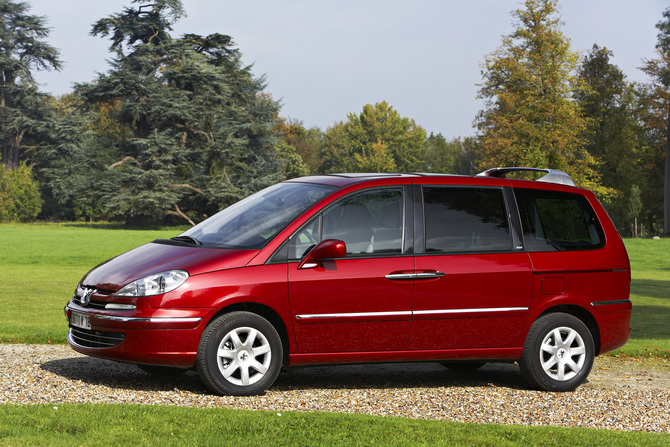
Red Peugeot 807 on Parking Area


Driving Interior Peugeot 807


Look so Elegant Peugeot 807 


White Peugeot 807 Wallpaper


Passenger Interior Peugeot 807


Blue Peugeot 807 Hatchback

Luxury Red Peugeot 807 Front View


Amazing Peugeot 807 on the Road

Related Posts Plugin for WordPress, Blogger...